Good vibrations: Testing touch as the next driving interface
2026-10-26 • Carter Staley

At what point does more visual information in a car stop being helpful? Modern vehicles are packed with sensors that generate a steady stream of data, and most of it reaches the driver through screens that pull attention away from the road. What if a driver could receive that information through touch instead?
That question drives research in WashU’s Sensory and Ambient Interfaces Lab (SAIL), led by Jonathan Hanahan, associate professor of design and founding chair of the Master of Design for Human-Computer Interaction and Emerging Technology (MDes) program in the Sam Fox School of Design & Visual Arts. The lab studies what Hanahan calls “compromised experiences”: high-stakes situations in which a screen would be unavailable, dangerous, or distracting. His team is developing a library of haptic patterns, or designed vibrations, that communicate information about a driver’s speed, their position within a lane, and hazards on the road.
A working prototype in ten weeks
This summer, the Digital Transformation Research Corps (DTRC) gave the project a way to test that idea. The team repurposed a steering wheel and a haptic vest designed for video games to build a working prototype during the ten week program. The vest delivers directional cues to the driver’s torso, a function that could one day be embedded into a driver’s seat. The simulator is also a testing platform that measures individual users’ feedback and performance in a controlled environment and collects EEG brainwave data. The student developers, Chiagozie Okoye and Mustafa Tahir, built the software with the aid of agentic coding tools that students in the DTRC are trained to use.
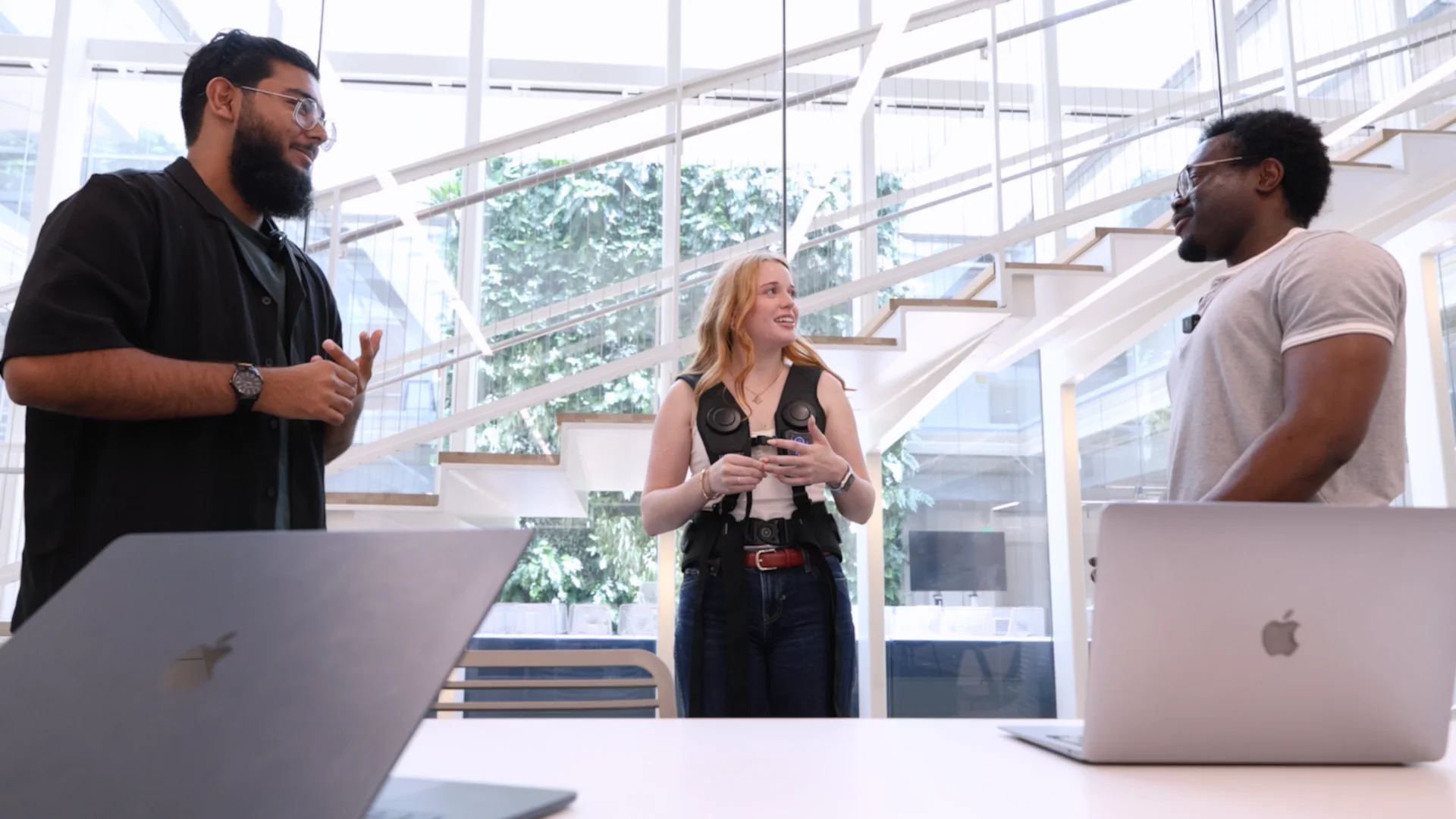
Hanahan had planned the summer in three phases and said the first was finished much sooner than expected. “Often we make a clunky thing that works, and then we just use it. Here, getting it running quickly helped inform design decisions, and then we could spend time with the designers and engineers to refine how it worked and test it.”
Designers and engineers, side by side
In addition to the student developers, design students from the MDes program were also embedded in each DTRC team to infuse design-thinking into the development process from the beginning. Okoye, a computer science major and student developer on the project, said that collaboration changed how the engineers approached their own work. “As a technical person, you tend to do everything conventionally. Non-technical people often ask, ‘Why would you do it this way?’ Having that voice tell you there might be a better way was really valuable.”
The lab is now using the platform to test which patterns drivers understand intuitively and which need to be redesigned. That evidence positions the project to pursue external funding to extend the work to other compromised settings, including athletics, medicine, and defense.
Faculty research applications for the 2027 Digital Transformation Research Corps are now open through November 30. Apply at di2.washu.edu/corps. Student applications open in December.